Thursday, 27 February 2014

Bilateral Security Relations Agreements Between India and Israel Signed

The Ministry of Home Affairs, Government of India signed three agreements to further strengthen the bilateral security relations with Israel here today. 

These agreements are Mutual Legal Assistance Treaty in Criminal Matters; Agreement on Protection of Classified Material and Agreement on Cooperation in Homeland and Public Security. 

The Agreements were signed on behalf of the MHA by Shri Rajiv Sharma, Additional Secretary. On behalf of the Govt. of Israel, two Agreements were signed by Mr. Alon Ushpiz, Ambassador of Israel in India and One Agreement by Mr. Amir Kain, Director, Ministry of Defence. 

The three Agreements were signed in the presence of Shri Anil Goswami, Home Secretary, Govt. of India. 

Courtesy: Press Information Bureau (pib.nic.in)

Rashtriya Swasthya Bima Yojna Extended to Auto/Taxi Drivers


                                                      Shri Oscar Fernandes Gives away Rsby Smart Cards to Drivers

Shri Oscar Fernandes, the Union Minister for Road Transport and Highways gave away smart cards under the Rashtriya Swasthya Bima Yojna (RSBY) to auto/taxi drivers in Faridabad today (27.02.2014). Speaking on the occasion Shri Oscar Fernandes said that the scheme will address the health concerns of auto rickshaw drivers and taxi drivers which form an important and vulnerable segment of the unorganized workers in urban areas. 

The nodal officer from Ministry of Road Transport and Highways for the scheme has been nominated. Nodal officers from States of Karnataka, Kerala, Jharkhand, Chhattisgarh, Uttar Pradesh, Haryana and West Bengal sand District Nodal Officer in each of the district in State with their name and contact details are also being notified for the purpose of implementation of the scheme. 

The auto rickshaw drivers and taxi drivers form an important segment of the unorganized workers in urban areas. The auto rickshaw drivers and taxi drivers are registered presently by the State Transport Authorities. In order to enroll the auto / taxi drivers under RSBY, States have been requested to identify such auto rickshaw drivers / taxi drivers and prepare their data in the format under RSBY. Owner driven rickshaw and auto drivers are also proposed to be covered under this scheme. Under the scheme, auto/taxi drivers have to contribute 50% of premium for the RSBY, as applicable in that district, in addition to Rs. 30/- as registration fee. Remaining 50% of premium would be shared by the Central and State Government i.e. 25% each. 

Ministry of Labour and Employment is going to commence shortly enrolment and issuance of smart cards to the beneficiary families under the RSBY in Karnataka, Kerala, Jharkhand, Chhattisgarh, Uttar Pradesh, Haryana and West Bengal shortly. The State Transport Authorities have been directed to facilitate the enrolment of maximum number of auto rickshaw drivers and taxi drivers with the State Nodal Agencies. 

A health insurance scheme, Rashtriya Swasthya Bima Yojana (RSBY) is being implemented by Ministry of Labour & Employment since 01.10.2007, providing for smart card based cashless health insurance cover of Rs. 30000/- per family per annum on a family floater basis to BPL families in the undersigned sector. RSBY coverage has now been extended to auto / taxi drivers in addition to various other categories of unorganized workers. 

Speech by the President of India, Shri Pranab Mukherjee at the inauguration of the Platinum Jubilee Celebrations of the Indian Newspaper Society

Ladies & Gentlemen,

It is indeed a privilege for me to be amidst you today on the occasion of the inauguration of the Platinum Jubilee Celebrations of the Indian Newspaper Society (INS). I offer you my warm felicitations. This is an important landmark for all of you, as indeed it is for all Indians. The Indian Newspaper Society has over the years met the challenges of time even as it has represented the most influential of India’s newspapers and periodicals.

Seventy five years ago, the world was a very different place. Our country was yet to take its place in the comity of nations. Millions of Indians were engaged in the struggle for freedom. Your Society came to life on the eve of the II World War. Newspapers of the time not only survived the shortages that war brought in its wake, but also engaged themselves in the difficult task of informing people of the momentous events of a contentious period in our history. It took resolve, vision and a sense of destiny on the part of the founding fathers to have formed a Society that could take up issues of common interest for its members. INS can also be proud that it helped create and nurture institutions like the Press Trust of India and the Audit Bureau of Circulation. INS members have played a vital role in nurturing a free Press which is a critical component of our democracy.

Over the years, INS members have informed society and promoted debate on the important questions that confront our nation. Be it the ravages wrought by war or those inflicted by the man-made Bengal Famine, the trials and tribulations of a nation torn asunder by Partition or the building of modern day India, newspapers have played a crucial role in educating Indians and giving expression to the diversity of views in our society, upholding thereby the fundamental right to freedom of speech and expression.

The plurality of media in our country has its roots in our freedom struggle. The Press in India evolved, not through the aegis of the Government but due to the commitment of individuals who used it as a tool to fight enforced opinions and create platform for social reform movements across the country. It is matter of pride that between 1780 until India’s Independence in 1947, more than 120 newspapers and periodicals were launched in almost in every Indian language. Each of these publications vowed to carry the ideals of democracy to the doorsteps of the people and spread the message of independence.

Ladies and Gentlemen,

As the media landscape undergoes change, the media has assumed different roles of being a facilitator, protector and enabler of democratic institutions and processes. Our vast, varied and vibrant media is a national asset. The Media as a whole not only keep people informed but also performs a very crucial function of presenting ideas and alternatives in the domain of policy formulation and implementation. The media space thus becomes an important component in the fabric of a functional democracy by not merely reporting the ‘dialogue of democracy’ but also by taking an active part in that dialogue.

As India grows in the 21st century, it is extremely important that media reaches out to the inaccessible areas and the under-served population of this country. It is critical that the media provides an enabling environment for the spirit of inclusive growth to be ushered in and that the varied tools of communication are able to disseminate the “India Story” in a positive, accurate and focused perspective.

Friends,

Even as iconic newspapers and magazines around the world are ceasing to print, our newspaper industry, one of the largest in the world, continues to grow. The market for Indian newspapers, with over 90 million copies in circulation, is expected to grow at a double-digit Compounded Annual Growth Rate of 10% and emerge as the world’s sixth-largest newspaper market by 2017. The regional and vernacular print sector, in particular, is growing on the back of rising literacy and low print media penetration as well as the heightened interest of advertisers wanting to leverage these markets. Today, according to industry sources, print media has a combined market penetration of only 14%. There is considerable potential, therefore, to expand readership across the national canvas.

These are changing times and it is not possible for the newspapers to be spared from the consequences of the evolution of ideas and the embrace of technology. It is essential for newspapers to be alive to the challenges of technology, and to harness responsibly the opportunities that present themselves.

The history of the Press in India bears testimony to the fact that the pioneers created strong and durable institutions as well as traditions. That is your inheritance and you must build on it. It is incumbent upon you as a Society of newspapers and periodicals to weed out such aberrations as might have crept into the functioning of the media.

Let me point out in this regard that it is distressing to note that some publications have resorted to “Paid News” and other such marketing strategies to drive their revenues. There is need for self-correcting mechanisms to check such aberrations. The temptation to “dumb down” news should also be resisted. The nation faces critical challenges that go well beyond the pressure of ‘Breaking News’ and immediate headlines. While you must continue to be effective raconteurs, you must also be visionary nation builders. You are after all the crystal ball that millions of Indians gaze at. It is your responsibility and your bounden duty to ensure that ideas are debated dispassionately and thoughts articulated without fear or favour so that opinion is always well informed.

Friends,

The influence, credibility and quality of our media is well recognized. Newspapers must be keepers of the conscience of our country. They have to be active participants in our continuing endeavour to nurture a democratic republic committed to achieving justice and fundamental freedoms for all citizens. Journalists must bring to public notice the array of ills and deprivations that continue to beset large numbers of our people – be it malnourishment, continuance of discriminatory practices against sections of society, particularly dalits, or the burdens and tragic consequences of indebtedness. They must shape and influence public opinion even as they provide objective and balanced coverage of news.

The media has an important role to play in cleansing public life. However, to undertake this role, the conduct of the media itself should be above board. It must be always kept in mind that ends and means are both important. The highest standards of ethics must be maintained at all times. Sensationalism should never become a substitute for objective assessment and truthful reporting. Gossip and speculation should not replace hard facts. Every effort should be made to ensure that political or commercial interests are not passed off as legitimate and independent opinion.

Integrity and independence are two sides of the same coin and both must be equally important for our media and for every one of us. There should be recognition that the media is accountable to its readers and viewers at large and through them to the entire nation.

As the fourth estate, the media is the mediator between the public and public servants. It is a watchdog of public interest. It gives voice to the downtrodden and dispossessed. It is inherent in the role of a watchdog that the media draws attention to what is wrong. But, gloom and dark alone should not dominate news coverage. A conscious effort must be made to highlight the positive and inspire change for the better. The power of the media should be used to engage in a nation-wide endeavour to reset our moral compass.

I call upon INS and all its members to remain torch bearers of responsible journalism. They must always be a voice for justice and equally, spokespersons of hope and reason.

In conclusion, let me remind that one of the most prolific and influential journalists as well as publishers of our nation was Mahatma Gandhi. His thoughts on journalism are most illuminating and must guide our media.

Gandhiji wrote in My Experiments with Truth:

“The sole aim of journalism should be service. The newspaper press is a great power, but just as an unchained torrent of water submerges whole countrysides and devastates crops, even so an uncontrolled pen serves but to destroy. If the control is from without, it proves more poisonous than want of control. It can be profitable only when exercised from within.”

He also wrote “Week after week I poured out my soul in its columns and expounded the principles and practice of satyagraha as I understood it. I cannot recall a word in these articles set down without thought or deliberation or a word of conscious exaggeration, or anything merely to please. Indeed, the journal became for me a training in self-restraint and for friends a medium through which to keep in touch with my thoughts.”

Thank you.

Jai Hind.

 Courtesy: Press Information Bureau (pib.nic.in)

Electoral Laws of India


India is a sovereign, socialist, secular democratic republic. Democracy is one of the inalienable basic features of the Constitution of India and forms part of its basic structure (Kesavanand Bharati v State of Kerala and Others AIR 1973 SC 1461).  The concept of democracy, as visualized by the Constitution, pre-supposes the representation of the people in Parliament and State Legislatures by the method of election (N P Punnuswami v Returning Officer Namakkal AIR 1952 SC 64). For democracy to survive rule of law must prevail and it is necessary that the best available men should be chosen as people’s representatives for proper governance of the country (Gadakh Yashwantrao Kankararao v Balasaheb Vikhepatil AIR 1994 SC 678).  And for the best available men to be chosen as people’s representatives, elections must be free and fair and conducted in an atmosphere where the electors are able to exercise their franchise according to their own free will.  Thus, free and fair elections form the bedrock of democracy.

India has adopted the British Westminster system of parliamentary form of government.  We have an elected President, elected Vice-President, elected Parliament and elected State Legislature for every State.  Now, we also have elected municipalities, panchayats and other local bodies.  For ensuring free and fair elections to these offices and bodies, there are three pre-requisites: (1) an authority to conduct these elections, which should be insulated from political and executive interference, (2) set of laws which should govern the conduct of elections and in accordance whereof the authority charged with the responsibility of conducting these elections should hold them, and (3) a mechanism whereby all doubts and disputes arising in connection with these elections should be resolved.

The Constitution of India has paid due attention to all these imperatives and duly provided for all the three matters. 

The Constitution has created an independent Election Commission of India in which vests the superintendence, direction and control of preparation of electoral rolls for, and conduct of elections to the offices of President and Vice-President of India and Parliament and State Legislatures (Article 324).  A similar independent constitutional authority has been created for conduct of elections to municipalities, panchayats and other local bodies (Articles 243 K and 243 ZA).

The authority to enact laws for elections to the offices of President and Vice-President and to Parliament and State Legislatures has been reposed by the Constitution in Indian Parliament (Articles 71 and 327).  Laws relating to conduct of elections to municipalities, panchayats and other local bodies are framed by the respective State Legislatures (Articles 243 K and 243 ZA).  All doubts and disputes relating to the elections to the office of President and Vice-President are dealt with by the Supreme Court (Article 71), whereas the initial jurisdiction to deal with all doubts and disputes relating to the elections to Parliament and State Legislatures vests in the High Court of the State concerned, with a right of appeal to the Supreme Court (Article 329).  The disputed matters relating to elections to municipalities, etc. are decided by the lower courts in accordance with the laws made by the respective State Governments.

The law relating to the elections to the offices of President and Vice-President of India has been enacted by Parliament in the form of Presidential and Vice-Presidential Elections Act 1952.  This Act has been supplemented by the Presidential and Vice-Presidential Elections Rules 1974 and further supplemented by the Election Commission’s directions and instructions on all aspects.

Conduct of elections to Parliament and State Legislatures are governed by the provisions of two Acts, namely, Representation of the People Act 1950 and Representation of the People Act 1951.

Representation of the People Act 1950 deals mainly with the matters relating to the preparation and revision of electoral rolls.  The provisions of this Act have been supplemented by detailed rules, Registration of Electors Rules 1960, made by the Central Government, in consultation with the Election Commission, under Section 28 of that Act and these rules deal with all the aspects of preparation of electoral rolls, their periodic revision and updating, inclusion of eligible names, exclusion of ineligible names, correction of particulars, etc.  These rules also provide for the issue of electoral identity cards to registered electors bearing their photographs at the State cost.  These rules also empower the Election Commission to prepare the photo electoral rolls containing photographs of electors, in addition to their other particulars. In exercise of these powers, the Commission is now preparing the electoral rolls for all parliamentary and assembly constituted in India with the photographs of electors containing therein, apart from the issue of individual identity cards to them.  

All matters relating to the actual conduct of elections are governed by the provisions of the Representation of the People Act 1951 which have been supplemented by the Conduct of Elections Rules 1961 framed by the Central Government, in consultation with the Election Commission, under Section 169 of that Act.  This Act and the rules make detailed provisions for all stages of the conduct of elections like the issue of writ notification calling the election, filing of nominations, scrutiny of nominations, withdrawal of candidatures, taking of poll, counting of votes and constitution of the Houses on the basis of the results so declared.

The superintendence, direction and control of elections vested by the Constitution in the Election Commission empowers the Commission even to make special orders and directions to deal with the situations for which the laws enacted by the Parliament make no provision or insufficient provision.  The classic example of filling such vacuous area is the promulgation of the Election Symbols (Reservation and Allotment) Order 1968 which governs the matters relating to recognition of political parties at the National and State level, reservation of election symbols for them, resolution of disputes between splinter groups of such recognised parties, and allotment of symbols to all candidates at elections, etc.

Another such vacuous area where the Election Commission exercises its inherent powers under Article 324 of the Constitution is the enforcement of the Model Code of Conduct for guidance of political parties and candidates.  The Model Code is a unique document evolved by the political parties themselves to govern their conduct during elections so as to ensure that a level playing field for all political parties is maintained during elections and, in particular, to curb the misuse of official power and official machinery by the ruling party(ies) to further the electoral prospects of their candidates.

All post election matters to resolve doubts and disputes arising out of or in connection with the elections are also dealt with in accordance with the provisions of the Representation of the People Act 1951.  Under this Act, all such doubts and disputes can be raised before the High Court of the State concerned, but only after the election is over and not when the election process is still on.

The above mentioned Representation of the People Acts 1950 and 1951 and the Registration of Electors Rules 1960 and Conduct of Elections Rules 1961 form complete code on all matters relating to elections to both Houses of Parliament and State Legislatures.  Any person aggrieved by any of the decisions of the Election Commission or the authorities functioning under it has to find a remedy in accordance with the provisions of these Acts and Rules.

These Acts and Rules enable the Election Commission to issue directions and instructions to deal with various aspects of the preparation/revision of electoral rolls and the conduct of elections and leave all such matters of detail to be dealt with by the Commission.  Pursuant thereto, the Commission has issued a plethora of directions and instructions which have been consolidated by the Commission in various compendia and the handbooks for the Electoral Registration Officers, Returning Officers, Presiding Officers, candidates, polling agents and counting agents.

The laws enacted by Parliament and supplemented by the Rules and by the Commission’s directions and instructions there under have come for scrutiny of the Supreme Court in several important matters from time to time and a significant contribution to supplement those laws and to reform the electoral system have been made by the Apex Court.  To give a few important examples, the Supreme Court in the case of Mohinder Singh Gill vs. Chief Election Commissioner (AIR 1978 SC 851) laid down that the Election Commission, being a creature of the Constitution, can supplement the laws made by the Parliament wherever the enacted law did not make a sufficient provision to deal with a situation arising in the course of the conduct of elections in a vast democracy like ours.  It is in the exercise of such powers, that the Commission is enforcing the Model Code of Conduct which is a unique contribution to the cause of free and fair elections by the political parties themselves.  Again, in the case of People’s Union for Civil Liberties (AIR 2003 SC 2363), the Supreme Court mandated that every candidate contesting an election to Parliament or a State Legislature must furnish, on affidavit, all details with regard to his criminal antecedents, if any, his assets and liabilities as also of his spouse and dependent children, as well as his educational qualifications so that electors, the ultimate rulers in democracy, can make an informed choice while electing their representatives.  Further, in the case of Resurgence India [LAWS(SC)-2013-9-35], the Supreme Court has recently laid down that if any candidate fails to furnish the requisite information in the abovementioned affidavit, dispute being reminded by the returning officer to do so, his nomination paper will be liable to be rejected by the returning officer at the time of scrutiny of his nomination papers.  Another significant contribution to the election law made by the Supreme Court has come in the case of  People’s Union for Civil Liberties[LAWS(SC)-2013-9-87], that a voter has a right to express his dis-satisfaction with all the candidates in the constituency and to caste a negative vote.  To operationalise this judgment of the Supreme Court, the Election Commission has provided an additional button on the voting machines with the inscription ‘NOTA’ (None of the above) by pressing which the voter has a right to express that he does not wish to vote for any of the candidate.  This enables the voters to express their desire in secrecy but the law does not say that if the number of votes recorded for the NOTA option is more than the highest number of votes recorded by any of the candidates, it will adversely affect his election.  In yet another landmark judgment in the case of Dr. Subramanian Swamy [LAWS(SC)-2013-10-20], the Apex Court held that the Electronic Voting Machines should have the provision for Voter Verifiable Paper Audit Trail (VVPAT) so that when a voter cast his vote, a paper slip is printed showing the name and symbol of the candidate for whom he has recorded his vote.  This will enable the voter to satisfy himself that the vote cast by him has been properly recorded and accounted for the candidate of his choice. 

S. K. Mendiratta
Legal Advisor, Election Commission of India

Courtesy: Press Information Bureau (pib.nic.in)


Wednesday, 26 February 2014

Rs. 15,158.11 Crore Released to 27 States Under “Backward Regions Grant Fund” Scheme Till the End of January- 2014

Government has released Rs. 15,158.11 crore to 272 selected districts in 27 states under “Backward Regions Grant Fund” (BRGF) scheme from 2010-11 till end of January-2014. 

The scheme implemented by Ministry of Panchayati Raj is gap filling in nature and aims at strengthening the Panchayati Raj Institutions (PRIs) across the country to enable them to discharge their duties for balanced development on the basis of schemes/programmes of different Ministries and States. 

The BRGF provides untied funds to Panchayats on the basis of plans prepared by various Ministries and States. Financial assistance under the scheme is provided to Panchayats through the States in the shape of grant for development and for capacity building. 

Along with BRGF, Ministry of Panchayati Raj also builds capacities of Panchayats through Rajiv Gandhi Panchayat Sashaktikaran Abhiyan (RGPSA), launched fully during 2013-14. Under RGPSA, in 2013-14, plans of 26 States for strengthening their Panchayats have been approved. 

Courtesy: Press Information Bureau (pib.nic.in)

India Russia Agree for Setting up Study Group for India–CU CECA

                                                     Indian Products Clear Market Access Issues in the Custom Union 
                                                     Anand Sharma Meets Russian Deputy Prime Minister 


India and Russia have agreed to a proposal for setting up a Joint Study Group for studying the scope of CECA (Comprehensive Economic Cooperation Agreement) with member-countries of the Customs Union viz Russian Federation, Kazakhstan and Belarus. This was conveyed in a meeting between The Union Minister of Commerce and Industry Shri Anand Sharma and Mr. Dmitry Rogozin, Deputy Prime Minister, Russia, here today. Keeping in view of the support of the Russian side on the idea of setting up a JSG for CECA between India and the CU, Russian side was requested to steer the process for CECA within the Eurasian Economic Commission. 

Russian Side also conveyed the resolution of issues pertaining to market access of egg powder. They informed that Indian entities have started getting the nod for export of egg powder for the Custom Union Markets. During the India-Russia Working Group on Trade & Economic Cooperation (IRWGTEC) (10th – 11th September, 2013), the Russian side had stated that market access can be given if the Indian products meet the requirements and norms of the Custom Union. The Indian side responded that the products match the international standards and the Department is ready to receive a delegation of food and veterinary authorities to inspect the facilities. Today Russian side also assured to expeditiously resolve the issue of recognition of Government approved Indian labs for enabling export of bovine meat from India. 

Both sides also reviewed the progress of identified ‘priority projects’. These projects include establishment of joint stock Indo- Russian enterprises for manufacturing light helicopters Ka-226T; establishment of joint stock Indo- Russian enterprises for manufacturing light helicopters Ka-226T; JSC United Aircraft Corporation preparation of participation in tender for Indian program to develop civil aircraft; plant construction for manufacturing butyl rubber with capacity of 100000 tons per year at the production site in Jamnagar. “Seeking to further strengthen the special and privileged strategic partnership and specifically to enhance the economic and investment cooperation between India and Russia on a bilateral basis, have identified investment projects and proposals for special attention”, said Shri Sharma. 

Courtesy: Press Information Bureau (pib.nic.in)

PM's Speech at the Foundation Laying Ceremony of CAPFIMS

Following is the text of Prime Minister, Dr. Manmohan Singh’s address at the Foundation Laying Ceremony of Central Armed Police Forces Institute of Medical Sciences, in New Delhi today: 

“Today marks a very important step forward towards the establishment of the Central Armed Police Forces Institute of Medical Sciences (CAPFIMS). It is a matter of great happiness for all of us that this project has finally reached the implementation stage. 

The Central Armed Police Forces Institute of Medical Sciences will serve a long-felt need. It will ensure better health care for the families of the Central Armed Police Forces personnel, who spend much of their time away from home discharging their arduous and onerous responsibilities. This will, in turn, lead to higher morale and more efficient functioning of these Forces. 

The Institute exemplifies our Government’s commitment to provide the best possible facilities to the Central Armed Police Forces. We are aware that the men and women of these Forces work in very adverse conditions, often at considerable risk to their lives. They are deployed in some of the most difficult places in the country including the Left-Wing Extremism affected States, the North-Eastern States and Jammu & Kashmir. The BSF, ITBP, SSB and Assam Rifles guard more than 15000 kilometres of our International Borders and the Line of Control (LoC) along Pakistan, China, Nepal, Bhutan, Bangladesh and Myanmar and also prevent trans-border crime. The CRPF assists the State Governments and the Union Territories in maintaining law and order and controlling internal disturbances and insurgencies. The CISF provides security cover to more than 300 units located all over India including our atomic power plants, space installations, our airports, mints, currency note presses, oil fields and refineries and major ports. 

The Central Armed Police Forces now have a strength of over 9 lakh personnel. Our Government had sanctioned 126 additional battalions in these Forces, out of which 71 battalions have already been raised and the remaining are expected to be raised within the current financial year. We have also given focused attention to strengthening infrastructure and building capacity. The 12th Plan outlay for strengthening infrastructure for Central Armed Police Forces is more than Rs.12500 crore. Since the year 2008, 24 new Training Institutes have been sanctioned for these Forces. 

Our Government has also made sustained efforts to improve healthcare facilities and expand the coverage and extent of medical cover to the Force personnel and their families. The medical cadre of the Central Forces was revamped in the year 2004, so as to provide the basic minimum healthcare facilities to the Forces’ personnel and their families even in remote postings. Six old hospitals were upgraded to 100 bedded Composite Hospitals, and 32 old hospitals to 50 bedded Composite Hospitals to provide specialty treatment. One 200 bedded Referral Hospital is under construction at Noida and is likely to become operational later this year. 

This Institute will be built at a cost of more than Rs. 1350 crore and will comprise of a 500 bedded General Hospital, a 300 bedded Super Specialty Hospital, a Nursing College and a School of Paramedics. It will not only improve the tertiary level health care facilities for the Central Armed Police Forces personnel and their families, but also contribute to an improvement in the other medical facilities available to them by producing doctors, paramedical staff and nurses fully familiar with their requirements. 

I would expect the Central Armed Police Forces Institute of Medical Sciences to be built and to commence functioning in the shortest possible time. I would also like to see it emerge as a centre of excellence in the time to come. Our Central Armed Police Forces deserve no less. 

Let me end by saying that we are all grateful for the services the Central Armed Police Forces have provided to our nation. We wish them all the best for the future. 

Thank you. Jai Hind.” 


Courtesy: Press Information Bureau (pib.nic.in)

Tuesday, 25 February 2014

Prime Minister Inaugurates “Indira Paryavaran Bhawan”; Bhawan is India’s First on Site Net Zero Building

The Prime Minister, Dr. Manmohan Singh at the dedication ceremony of the Indira Paryavaran Bhawan to the Nation
Courtesy: Photo Division

Dr. Manmohan Singh, Prime Minister of India dedicated to the Nation “Indira Paryavaran Bhawan” in the presence of Dr M. Veerappa Moily , Minister for Environment & Forests and Shri Jairam Ramesh Minister for Rural Development here today . The centrally air conditioned office building which has provision to accommodate about 600 officials of the Ministry of Environment and Forests is located on Jorbagh Road and in proximity to other Central Government Ministries/Departments. 
            Indira Paryavaran Bhawan is India’s first on site Net Zero Building built by adoption of solar passive design and energy efficient building material.  This building is expected to be a trend setter in the country and shall inspire people towards adoption of green technology.
The building has been designed as the highest green rated building, i.e., GRIHA 5-Star and LEED India Platinum. The requirements of GRIHA 5-Star and LEEDS Platinum ratings have been achieved by adopting various measures some of which are as follows:
(i)                  Effective Ventilation has been achieved by orientating the building in an East-West direction, separating different blocks with connecting corridors and having a large central court yard.
(ii)                The design is such that 75% of natural daylight is utilised to reduce energy consumption.
(iii)               The entire building has an access friendly design for differently-abled persons.
(iv)              With an Installed capacity of 930 KW peak power, the building has the largest roof top Solar system among  Multi storied buildings in India.
(v)                Total energy savings of about 40% has been achieved by adoption of energy Efficient Chilled Beam system of Air Conditioning. This is an innovative air conditioning system, where air conditioning is done by convection currents rather than air flow through diffusers and chilled water is circulated right up to the diffuser points unlike the conventional systems.
(vi)              Green materials have been used like Fly ash bricks, regional building materials, materials with high recycled content, high reflectance terrace tiles and rock wool Insulation of outer walls.
(vii)             Rapidly renewable Bamboo Jute Composite material has been used for door frames & shutters.
(viii)           UPVC windows, with hermetically sealed double glass. Calcium Silicate ceiling tiles having high recycled content andgrass paver blocks in pavements and roads.
(ix)              Reduction in water consumption has been achieved by use of Low discharge water fixtures, recycling of waste water through Sewage Treatment Plant, use of plants with Low water demand in landscaping, use of Geothermal cooling for HVAC system, rain water harvesting and use of curing compounds during construction.
The cost of the project is about Rs. 209 crore including the cost of land, solar photo voltaic power generation and its evacuation system, three level mechanized basement parking system, air-conditioning system supported by geo-thermal cooling, IT services, audio and video system in auditoriums & committee rooms, furniture, provision for horticulture and other services. The building has an earthquake resistant structure with a total plinth area of  31,488sqm. The building covers only 30% of the plot area. More than 50% area, outside the building, is a soft area with plantation and grassing. Even circulation roads and pathways are a soft area to enable ground water recharge. 
            Robotic parking system in the basement can accommodate 330 cars. Provisions have been made for a cafeteria roof garden, as well as a gymnasium and yoga room for recreation and wellness of the employees. The office has been furnished with modular furniture & work stations. Thin client networking system has been provided instead of conventional desktop computers to minimise energy consumption. A Solar power generation system has been provided at terrace level, by creating 6000sqm support area, for meeting with the complete power demand of the building. Power generation has already started w.e.f. 19.11.2013 which is being fed to the NDMC grid.
The Indira Paryavaran Bhavan building has already received the following awards.
Feb 2013The Project received an award from Adarsh/GRIHA of MNRE for exemplary demonstration of Integration of Renewable Energy Technologies
Jan. 2014: The Project was accorded 5-Star Green Building Certification by GRIHA under MNRE
Courtesy: Press Information Bureau (pib.nic.in)

Successful Trials of Akash Surface to Air Missile System

Akash Surface to Air Missile System successfully flight tested at the Integrated Test Range (ITR), Chandipur.
Courtesy: Photo Division

Akash the indigenously designed developed and produced Surface to Air missile for the Indian Army was once again successfully flight tested today (24.02.2014) at the Integrated Test Range (ITR), Chandipur. These were part of a series of trials being conducted in various engagement modes from the first of Production Model system being produced to equip two regiments of Indian Army. Both, today’s flight destroying a target in receding ting mode, as well as the one conducted on 21st Feb 2014 destroying an approaching target, fully met the mission objectives and few more trials are planned in different 
engagement modes. 

“Development and production of Akash weapon system with the active participation of DRDO labs, Public Sector Units (PSUs), Ordnance Factories, National R&D Laboratories, academic Institutions and about 200 private industries is yet another symbol of India’s strength in making indigenous weapon systems”, stated Shri AvinashChander, Scientific Advisor to RakshaMantri and Secretary Deptt of Defence R&D, congratulating the production agencies, Indian Army and DRDO team. “The successful trials show the continuing excellence of Indian weapon systems”. 

‘Akash’ is India’s first indigenously designed, developed and produced air defence system Surface to Air missile capable of engaging aerial threats upto a distance of approximately 25 kms. The multi target, multi directional, all weather air-defence system consisting of surveillance and tracking radars, control centres and ground support systems mounted on high mobility vehicles for the “Army” version of Akash is designed to enable integration with other air defence command and control networks through secured communication links. Developed by DRDO, the Army version of Akash is being produced by Bharat Dynamics Limited (BDL) as the nodal production agency with the involvement of Bharat Electronics Limited (BEL) and a large number of other industries. The total production value of Akash air defence systems cleared for induction by Indian Army and Indian Air force is more than Rs 23,000 crore. 

Sh. G Chandramouli, Project Director Akash supervised the overall trial operations in the presence of senior army officials and officials from BDL and BEL who are attending the trials. 

Courtesy: Press Information Bureau (pib.nic.in)

Monday, 24 February 2014

Sanction of Pension Simplified and Streamlined

As a part of a larger mandate of streamlining and simplifying the sanction of pension and payment process, the Department of Pension and Pensioners’ Welfare has taken steps towards minimizing delays in sanction and disbursement of pension, and making the process more transparent. 

The objective is to simplify the forms as well as to do away with the requirement of submission of affidavit and to accept all information and documents on the basis of Self certification. 26 forms under CCS Pension Rules (1972) have been reviewed and modified where necessary. The revised forms have been posted on the website of the Department www.persmin.nic.in. 

The Department proposes to dispense with the requirement of a number of nomination forms for various benefits like GPF, CGEGIS, arrear of Pension and commutation of Pension by the employees. Instead, an employee will be required to fill up only one Nomination Form during the service and another nomination Form at the time of retirement. Amendment to the Forms and relevant rules in this respect would be notified by the Department very soon. 

Revision of Forms under General/Contributory Provident Fund Rules, Extraordinary Pension Rules and Commutation of Pension Rules is under process. The Department is also reviewing the Rules with a view to reducing the time prescribed for sanction of pension from the current 24-30 months to a more reasonable 12 months. 

An online pension sanction and payment tracking system ‘Bhavishya’ has been launched, initially in 15 Ministries. This will enable retiring government servants to themselves track progress of sanction of pension and other retirement dues against the time lines prescribed. 

Courtesy: Press Information Bureau (pib.nic.in)

Magazine Industry Should emerge as an Objective & Authentic Source in an Information-Loaded World: Manish Tewari

I&B Minister inaugurates 8th Indian Magazine Congress

24 फरवरी, 2014 को नई दिल्ली में आयोजित आठवीं इंडियन मैग्जी न कांग्रेस से संबंधित कार्यक्रम में उपस्थित लोगों को संबोधित करते केंद्रीय सूचना एवं प्रसारण राज्य मंत्री श्री मनीष तिवारी।
The Minister of State (Independent Charge) for Information & Broadcasting, Shri Manish Tewari addressing at the 8th Indian Magazine Congress, in New Delhi on February 24, 2014. 
Courtesy: Photo Division
The Minister for Information & Broadcasting Shri Manish Tewari has called upon the Magazine industry to strengthen its presence in the Digital and New Media Age by playing the role of an objective, analytical and authentic source of information. Innovation needed to be used as a sustained tool for bringing the change in the lives of the readers rather than being a tool for ‘short-cut’ solutions. Shri Tewari stated this while delivering the inaugural address at the 8th Indian Magazine Congress here today on the theme “Winning through Innovation”.
Elaborating further, Shri Tewari said that in recent times, many iconic publications had turned digital and the need of the hour was to empower the world wide web through agreed rules of engagement.  It was necessary for the digital world to go through standard editorial checks so as to ensure rich and authentic content in the New Media Space. The challenge before the magazine industry was to withstand the flow of instant information emerging from different media streams.
On the magazine industry trends, Shri Tewari said the industry’s future performance would be a critical player determining the macroeconomic environment necessary for  print media stakeholders.  This would be possible if  the Industry was able to achieve  greater operational efficiencies and connect with readers through delivery of high quality content. The industry could focus on profitable growth by implementing cost control initiatives and adopting technology across key business performance areas such as planning, budgeting, customer relationship management, strategic outsourcing, etc. While leading players had taken necessary steps, it was necessary that the industry reviewed the process in its entirety.

 On the trends for the print media industry, the Minister stated, the market for regional and vernacular markets continued to grow in an environment which was fruitful in view of rising literacy levels, low print media penetration in certain areas and the desire of stakeholders to use the platform. The Minister further added that the inherent advantages of print industry – extensive reach, localisation benefits and ability to create trust and achieve a higher ‘attention span’, were expected to serve as a base for growth and ensure that print continues to be one of the most important platforms for Indian advertisers.
Shri Tewari further said that in marked contrast to the global trends, the Indian print industry was growing with steady increase in both advertising and circulation revenues. Although, internet broadband penetration has been increasing at an enormous pace, print industry would continue an upward trajectory due to growth in vernacular and regional markets. The Magazine Industry, both vernacular and English, had shaped public discourse for over 60 years and still had potential to grow.
Speaking on Digitization Shri Tewari mentioned that the first two phases had provided a learning experience as far as implementation of the process was concerned. These learnings would be incorporated  while implementing the remaining two phases. The Minister reiterated that Digitization was bound to be a game changer for the sector  and would define contours of orderly growth. Digitization while providing qualitative choices to the consumer would also ensure that the subscription revenues and skewed business models were rectified.

Courtesy: Press Information Bureau (pib.nic.in)

India and Canada Sign Audio-Visual Co-Production Agreement


Agreement signed between Secretary I&B and High Commissioner of Canada

India and Canada have signed an Audio-Visual Co-Production Agreement which will enable Indian and Canadian film producers to utilize a platform for collaboration on various facets of film making. The agreement is expected to deepen the engagement between the critical sectors of the film industries of both countries there by, providing a new chapter of collaboration. The agreement was signed by the Secretary I&B, Shri Bimal Julka and Mr.Stewart Beck, High Commissioner of Canada to India here today.
The agreement between India and Canada is expected to benefit producers from both the countries in pooling their creative, artistic, technical, financial and marketing resources for the co-production. It will also lead to exchange of art and culture among the two countries and create goodwill and better understanding among the people of both the countries thereby boosting cultural ties between the two countries.
The agreement will also provide an opportunity to create and showcase India’s ‘Soft Power’ and lead to employment generation among artistic, technical and non-technical human resources engaged in the film production including post-production and its marketing.
Since the agreement is expected to boost the utilization of Indian locales for shooting it will increase the visibility/prospects of India as a preferred film shooting destination across the globe and will lead to the inflow of Foreign Exchange into the country. The agreement will also lead to the transparent funding of the Film Production and will boost export of Indian Films into the Canadian Market.
Earlier, The Government of India has signed similar agreements with the Government of Italian Republic in 2005, Government of United Kingdom of Great Britain and Northern Ireland in 2005, Federal Republic of Germany in 2007, Government of the Federative Republic of Brazil in 2007, Republic of France in 2010, Republic of New Zealand in 2011, Republic of Poland in 2012 and Republic of Spain in 2012.
The Co-production agreements signed so far seek to achieve economic, cultural and diplomatic goals. For filmmakers, the key attraction of a treaty co-production is that it qualifies as a national production in each of the partner nations and can access benefits that are available to the local film and television industry in each country. Benefits accruing from such agreements include government financial assistance, tax concessions and inclusion in domestic television broadcast quotas. 
India’s co production agreements are unique for international producers as the Country offers technically qualified film crew at reasonable rates, a large pool of talented actors and the multitude of shooting locations. The other benefits are that the co production is treated at par as a national film and is eligible for the National Film Awards and the Indian Panorama section of IFFI. Such films also get the opportunity to be released through the Indian distribution network, and hence co production opens up the Indian consumer market to the foreign producer.
Courtesy: Press Information Bureau (pib.nic.in) 
Friday, 21 February 2014

National Youth Policy 2014: Enabling India’s Youth to realize their dreams


The vision of NYP-2014 is to empower youth to achieve their full potential, and through them enable India to find its rightful place in the community of nations. For achieving this vision, the Policy identifies five well-defined objectives and 11 priority areas and suggests policy interventions in each priority area. The priority areas are education, skill development and employment, entrepreneurship, health and healthy lifestyle, sports, promotion of social values, community engagement, participation in politics and governance, youth engagement, inclusion and social justice. 

The focused approach on youth development and empowerment involving all stakeholders, as envisaged in NYP-2014, would result in development of an educated and healthy young population, who are not only economically productive, but are also socially responsible citizens contributing to the task of nation-building. 

It will cover the entire country catering the needs of all youth in the age-group of 15-29 years, which constitutes 27.5 per cent of the population according to Census-2011, that is about 33 crore persons.It will replace NYP-2003, to take care of developments since 2003 and future policy imperatives. 

The NYP-2014 proposes broad policy interventions for the youth consistent with the 12thPlan priorities and does not propose any specific programme/ scheme, having financial implications. All concerned Ministries/ Department would be requested to bring focus on youth issues within the framework of their plans/ programmes/ schemes etc. 

Background:

India is one of the youngest nations in the world and is expected to have a very favourable demographic profile in the near future. This is a great opportunity as well as a challenge. NYP-2014 seeks to suggest a framework for appropriate policy interventions by Government and non-Government stakeholders, to empower the youth to enable them to realize their full potential as also to contribute to the progress of the nation. 

Courtesy: Press Information Bureau (pib.nic.in)

Thursday, 20 February 2014

Launching of Web Portal on Anti Human Trafficking

Shri R.P.N.Singh, Minister of State for Home Affairs launched a comprehensive web-portal on Anti Human Trafficking Portal here today. The web portal will serve as a vital IT tool for sharing of information across all stakeholders, States/UTs and civil society organizations for effective implementation of Anti Human Trafficking measures. 

Shri R.P.N.Singh mentioned that the web portal will help in tracking large number of cases having inter-state ramifications. This portal will also act as one stop information repository on issues relating to trafficking including details of Anti-Human Trafficking Units (AHTUs), their locations, contact details of Anti-Human Trafficking Nodal Officers. 

Addressing the Nodal Officers of Anti Human Trafficking Units, Shri R.P.N.Singh said that this site will also provide comprehensive information on legislations , statistics important judgements, UN Conventions, details of Trafficked persons and Traffickers, rescue success stories. Moreover, it will provide an important link to National Portal on Missing Children, ‘Trackchild’ which is operational in many States. 

Trafficking in persons, particularly in women and children for various purposes such as commercial sexual exploitation (CSE), forced labour, forced marriages, domestic servitude, etc. is an organized crime that gravely violates basic human rights. The Government has adopted a multipronged approach to combat the crime of human trafficking. Ministry of Home Affairs is implementing a Comprehensive Scheme in States / UTs to strengthen the law enforcement response to human trafficking. The Scheme involves establishment of Integrated Anti Human Trafficking Units (AHTUs) in 335 vulnerable police districts throughout the country and capacity building of responders, which includes Training of Trainers for Police, Prosecutors and Judiciary. So far 225 Integrated Anti Human Trafficking Units have been made operational in different districts of the country and 100 more AHTUs are proposed to be established in the current financial year. 

For capacity building of law enforcement agencies and other stakeholders, Training of Trainers workshops at Regional, State and District Level are being held regularly. Training of Trainers workshops for Prosecutors are also being held at Regional, State and District level. Judicial Colloquiums are being held throughout the country for sensitizing Judicial Officers. So far six Judicial Colloquiums have been held. A certificate course has also been launched by Indira Gandhi National Open University on Human Trafficking in collaboration with MHA. 

A Regional Task Force was constituted to implement the SAARC Convention on prevention of Trafficking in Women and Children. So far five meetings of the task force have been held. Ministry of Home affairs conducted a workshop for representatives of SAARC Member countries for capacity building in combating Human Trafficking at New Delhi from 19-20th November, 2012 in which representatives of all SAARC Member Countries participated. A study tour for SAARC Member countries regarding functioning of AHTUs was also conducted from 18th to 22nd November, 2013. 

The Government of India, had enacted and strengthened legislative measures in the form of Criminal Law (Amendment) Act 2013 which has come into force from 3rd February 2013. In the new Act, Section 370 of the Indian Penal Code has been substituted with Section 370 and 370A IPC which comprehensively defines Human Trafficking and provides stringent punishment for human trafficking; trafficking of children for exploitation in any form including physical exploitation; or any form of sexual exploitation, slavery, servitude or the forced removal of organs. 

This will also enhance cooperation between law enforcement agencies, and concerned government departments as well. The nodal officers of all States and UTs are inter connected with each other and will be given a login ID through which they can access this web portal and upload real time statistics and success stories and other case studies. Details of trafficked persons will be uploaded on the web portal and other relevant contents regarding Anti Human Trafficking has also been uploaded for the convenience of the user. 
Courtesy: Press Information Bureau (pib.nic.in)

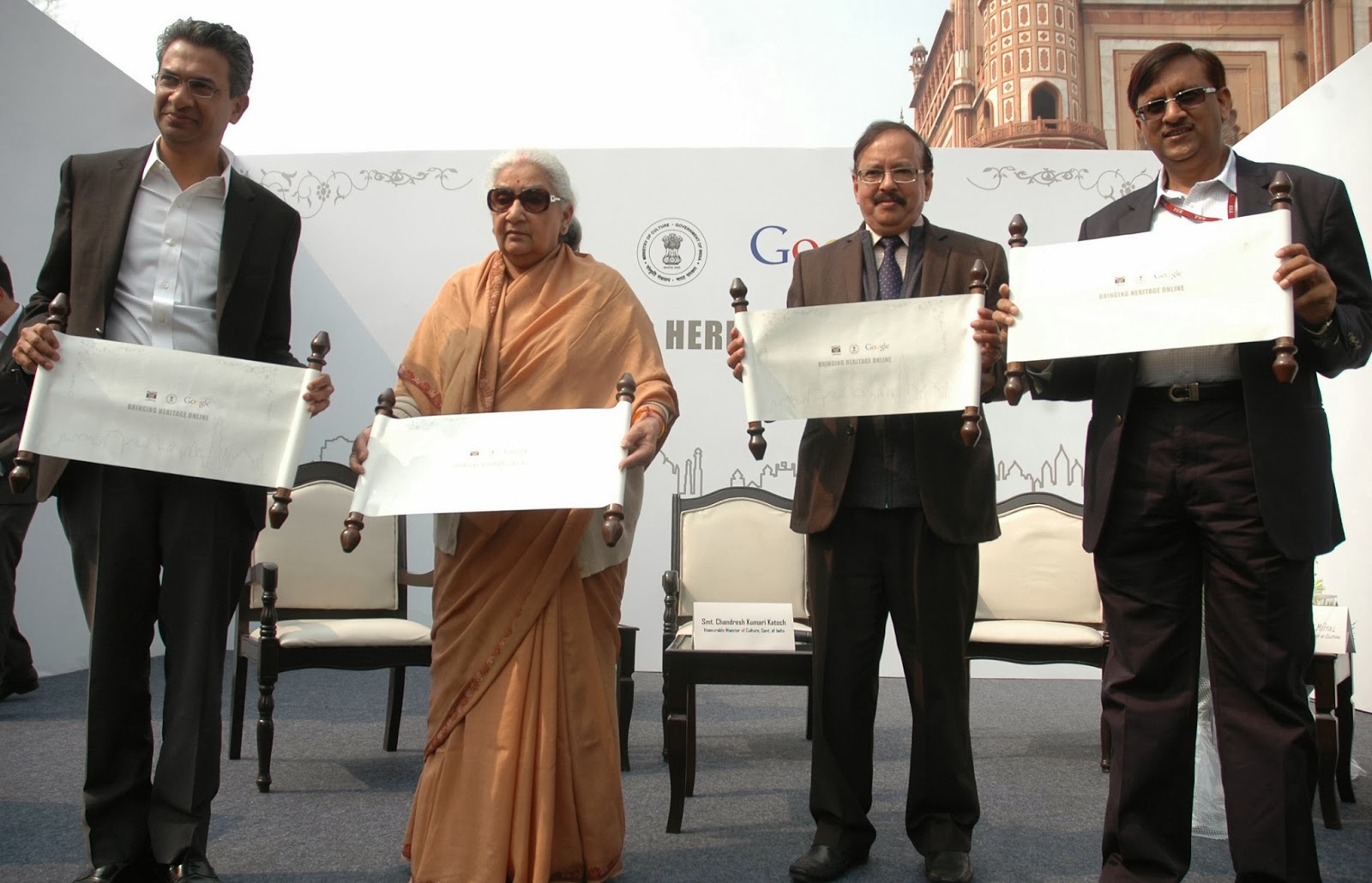
Bringing India’s Heritage Online

Courtesy: Photo Division

The Minister of Culture Smt. Chandresh Kumari Katoch here today released first set of imagery of monuments for bringing India’s Heritage online. 

Following is the text of the speech of the Minister on the occasion: 

“I would like to extend a warm welcome to all of you for today’s event. In its 152nd year, it is commendable that the ASI is taking forward its mission of embracing partnerships for the future in order to preserve and propagate the rich heritage of India’s past. In the UPA’s 2012-2013 Report to the People, Culture was listed under the “New Horizons” chapter of our Government’s statement of work being done for the nation. Therefore, I am very happy to be here to celebrate the successful culmination of an agreement that the Ministry of Culture and the Archeological Survey of India (ASI) entered into with Google in 2013. 

Last year, in the backdrop of one of India’s world heritage sites, the Qutub Minar, I had announced the flagging-off of this exciting partnership towards Bringing India’s Heritage Online. Over the last few months, teams from Google and the ASI have worked together to digitize and make available the experience of visiting the many wonderful heritage sites present across India and to tell their stories using the latest technologies available. 

I have been told that this is one of the most unique cultural partnerships entered into by Google with the widest range of monuments covered under a single national project undertaken by them and a matter of pride for us all. 

Today, this project makes it possible for billions of people across the world to see and explore our magnificent heritage in the virtual world. 

As you are aware, the Ministry of Culture’s aim is to preserve, promote, and disseminate India’s art and culture. The last year has seen a number of celebrations and successes in the cultural sphere. Our national icons such as Amrita Shergil and Vivekananda are celebrated globally, a powerful reminder of the richness of India’s heritage and culture. Thanks to the combined efforts of ASI and the Ministry of Culture, the Hill Forts of Rajasthan were conferred the status of World Heritage Sites by UNESCO last year. 

I am glad that the Ministry had the chance to work with Google’s Cultural Institute and helped launch the India chapter of the Google Art Project in 2012 featuring the National Museum and the National Gallery of Modern Art. We hope to continue working with Google, to bring more of the richness of India’s archeological heritage online in order to improve the visitor experience to our heritage sites globally via the Internet. I request you to join me in celebrating the success of this project and taking it to new heights.” 

Courtesy: Press Information Bureau (pib.nic.in)

Approval of National Mission for a Green India Scheme


The Cabinet Committee on Economic Affairs has approved a proposal of the Ministry of Environment and Forests for a National Mission for a Green India (GIM) as a Centrally Sponsored Scheme. 

Of the total expenditure of Rs. 13,000 crore envisaged in the 12th Plan, the plan outlay is Rs.2000 crore. The source of funding for the scheme would be from the Plan outlay, and convergence with MGNREGA activities, CAMPA and the NAP. The sharing pattern for the plan outlay would be 90 Centre and 10 State for the North Eastern States and 75 Centre and 25 State for the rest of the States. The 13th Finance Commission grant funds may be counted towards the States' share, to the extent that this is in conformity with the Commission’s award. 

The objectives of the Mission during 12th Plan period includes increased forest/tree cover and improved quality of forest cover in two to eight million hectares, alongwith improved ecosystem services including biodiversity, hydrological services, increased forest-based livelihood income of households, living in and around the forests, and enhanced annual CO2 sequestration. 

Mission implementation will be on a decentralized participatory approach with involvement of grass root level organizations in planning, decision making, implementation and monitoring. The gram sabha and the committees mandated by the gram sabha, including revamped JFMCs will oversee implementation at the village level. Revamped Forest Development Agency (FDA) under the Chair of an elected representative at district/division level, revamped State Forest Development Agency with a Steering Committee chaired by the Chief Secretary and an Executive Committee chaired by the Principal Chief Conservator of Forests at the State/U.T. level. A Governing Council, chaired by the Minister Environment and Forests and a National Executive Council chaired by the Secretary (E&F) and co-chaired by the DGF&SS with the Mission Director as the Member Secretary at the national level will facilitate Mission implementation. A multidisciplinary team, both from Govt. and NGOs will be mandated to facilitate planning and implementation at cluster/landscape unit level. 

Courtesy: Press Information Bureau (pib.nic.in)

Extension of Emergency Credit Line Guarantee Scheme through ECLGS 2.0 for the 26 sectors identified by the Kamath Committee and the healthcare sector

Extension of the duration of Emergency Credit Line Guarantee Scheme (ECLGS) 1.0 The Government has extended Emergency Credit Line Guarantee ...